
Biography & History
A brief History and Guide to the Gardens and Marshland at Hickling Long Gores (UK)
Please note that there is no public right of way to the gardens and marshland, but private escorted viewings can be arranged. In the first instance, please use the contact form to introduce yourself.
Residence of Marietta Pallis between 1915-1963
Marietta Pallis was born in Bombay in 1882, the eldest of five children of a Greek merchant, Alexander Pallis, who had married into the well-established Greek trading family of Ralli Brothers. On the family’s return from India in 1889, Marietta was subsequently brought up and educated in Liverpool, where she studied botany and zoology and developed an interest in wetland ecosystems with field trips into the Dee Estuary. She also attended Newnham College Cambridge in 1910-11.
Her association with Hickling began in 1907 when she started a series of long fieldwork visits to the Norfolk Broads, studying the salinity of this particular stretch of coastal wetlands (published in the Geographical Journal in 1911), and the vegetational ecosystems of the Broads river valleys more widely for the ‘Norfolk chapter’ of Types of British Vegetation, a seminal work in the field of early ecology, published by Cambridge University Press, also in 1911.
In 1912 & 1913 she made journeys to study the floating fen of the delta of the Danube. Her work, including the discovery of a Balkan ash new to science (Fraxinus pallisiae), was published by the Linnean Society in 1916.
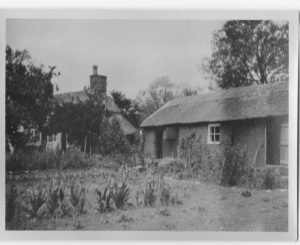
Marietta Pallis first rented the cottage buildings at Long Gores sometime during WW1. In those days the cottage was extremely primitive, with no running water or other modern amenities, and what is now the Cottage Apartment was a separate stables building. Horses were still being grazed on the marshes, and a summer crop of marsh hay harvested. Marietta bought the whole site after her father’s death in 1935, after which the marshland was left to go wild. The Studio was built as a summer workplace in 1937.
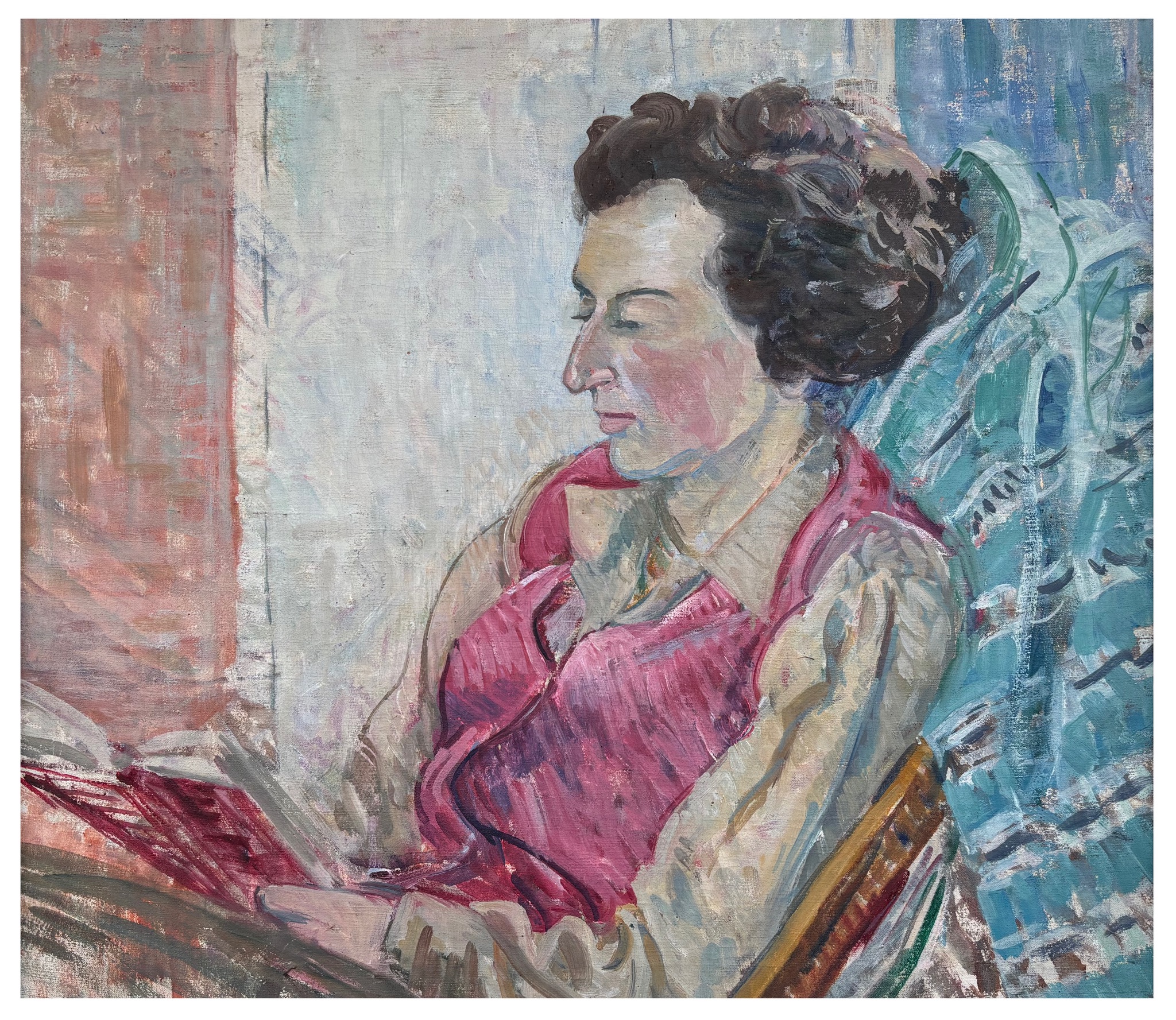
Although she had been on the cutting edge of the new science of vegetational ecology, Marietta Pallis was strongly independent in character and disinclined ever to be subservient to anyone else’s establishment. Therefore she never embraced a career in academia, and turned to painting as a principal pastime after about 1920, though she later returned to independent scientific publication engaging with the research on the origin of the Broads which emerged during the 1950s and 60s.
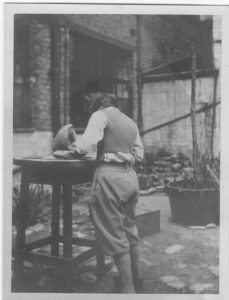
She maintained a Bohemian house in Cheyne Walk, Chelsea which before WW2 backed onto the World’s End slums. A talented artist since her childhood, she was much influenced by the post-impressionists, particularly Cézanne, whose work she studied in Paris when much of it was still in a private collection. She trained at the Slade School in London during 1923 under the celebrated Professor Henry Tonks, and exhibited with the London Group in 1926 and 1929, took sculpting lessons with Henry Moore in 1931, and had an exhibition of her own work at the Bloomsbury Gallery in 1938. Most of her artwork was given away rather than sold.
Marietta at work on a sculpture in the yard at Cheyne Walk
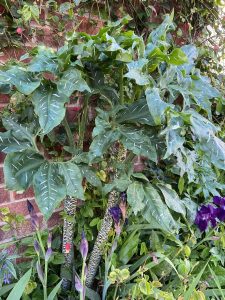
A specimen of Fraxinus pallisiae grows in the tall hedge at the bottom of the Long Gores driveway opposite the end of the cottage, and others are planted round the borders of the Double-Headed Eagle Pool on the marsh (see picture below). Her plant-collecting over many years of travels in the Balkans and eastern Mediterranean is still strongly represented here, particularly by Dranunculus vulgaris (the Cretan Dragon Arum), collected by her in seed in 1930 and growing here ever since, and includes species galanthus and ornithogalum, and the Danubian mallow Kitaibela vitifolia. Her travels are also frequently represented in her paintings.
Dranunculus Vulgaris
The main influence on the existing gardens is due to the input of Alexis Vlasto, Marietta’s nephew, who inherited Long Gores in 1963. A scholar who specialised in Slavonic languages and history, he was also a knowledgeable collecting plantsman who enjoyed close links with the botanists and gardens of Cambridge University. Among the Balkan species collected by him for the Cambridge Botanical Gardens was seed of the then little-known Silene viscariopsis, from which plants were later distributed to gardens throughout the world.
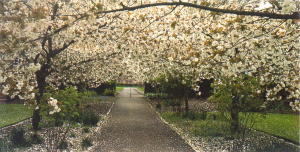
Alexis Vlasto served as Selwyn College’s Gardens Steward during a period of extensive replanting of their gardens in Grange Road. The great distinctions of the Selwyn gardens apart from Mediterranean rarities are, firstly, one of the finest rose-gardens in Cambridge with over 220 species and cultivars, and secondly a magnificent cherry walk of Prunus taihaku “that drip blossom and resound to the buzzing of millions of bees … on a sunny day [in April], walking up and down under these trees is an experience that will not be forgotten” (Richard Bird in The Gardens of Cambridge, Covent Garden Press, 1994). This avenue has, however, suffered recently from ageing trees and some nearby buildings extensions.
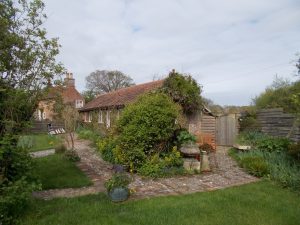
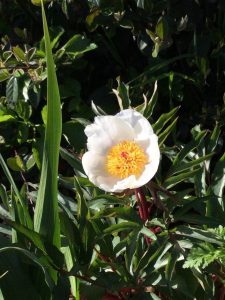
The garden at Long Gores was filled with many of the same features – a single taihaku here and most of the older roses being obvious examples. An unusual Magnolia x thompsoniana was originally planted to umbrella the kitchen courtyard. Abutilon megapotamicum and Clematis ladakhiana outside the Cottage Apartment, were also part of his planting. But after Alexis Vlasto’s death in 2000, numerous plants from his Cambridge garden were moved and replanted here. Perhaps chief among these were the Cretan Paeonia clusii (illustrated), seeds of which were collected from the Gorge of Samaria in 1971, and Pancretium maritimum collected from the Vlasto ancestral island of Chios.
Transplants from Cambridge also included Veratrum nigrum (black false helleborine, collected in Yugoslavia), many cyclamen including spring-flowering repandum, autumn-flowering Galanthus regina olga, Muscari macrocarpum, Scilla peruviana and the South American nasturtium Tropaeolum polyfullum.
With the exception of a large walnut tree planted in about 1968, everything that has been planted or established in the environs of the Studio is the work of the past 20 years, and is based around Alexis Vlasto’s extensive collection of old bearded irises, some of which were Cedric Morris ‘Benton’ irises already in the garden of his Cambridge house when he moved into it in 1947.
Apart from developing the gardens around the Studio, the main preoccupation of the current owner, Dominic Vlasto (Marietta’s great-nephew), since about 1990 has been the restoration and management of the adjoining marshland – which he considers to be simply gardening (or at least weeding and pruning), but on a rather larger scale.
After 70+ years of being left to nature, encroaching scrub and trees had forced out a lot of water margin and wet marsh species; but this was less of a problem on the central, slightly lower area of marsh, where the ground level had been reduced by mediaeval peat-digging for the neighbouring Hickling Priory. This central low marsh section still held sporadic milk-parsley (Peucedanum palustre), the food plant for swallowtail butterfly caterpillars. It is now regularly grazed, and a crop of marsh hay is harvested in August.
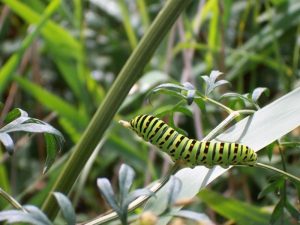
There was a dramatic increase in milk-parsley following clearance and re-digging of old and several new drainage ditches. This work started first round Marietta’s island, which she had excavated from the peat in 1953, and where both she and her long-time companion Phillis Clark are now buried.
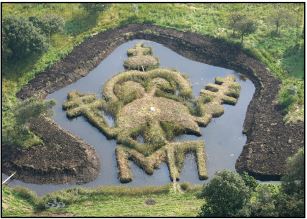
The Double-Headed Eagle Island